freedom in emptiness
Wed 08 Apr
|6-week course on Zoom
an exploration of the teaching of emptiness in the Buddhist tradition
Times & Location
08 Apr 2026, 18:30 – 20:30 BST
6-week course on Zoom
About
'Although the word ‘emptiness’ can seem a bit intimidating, in the Buddhist traditions it is the key to freedom. Our mind is intrinsically empty of self and any fixed or defining content. We are not defined by anything which has occurred, that is occurring now, or will occur in the future. Being empty of fixed content allows us to open to all that occurs without being trapped in reactivity. By opening to our own unborn openness we are freed from the delusion that our transient patterning points to the truth of who we are.' James Low
How can we not just understand the term 'emptiness', but allow that understanding to show us the open door to freedom every day? How can we embrace this greatest possible openness in our practice, and become present to what is already here?
'The open emptiness of the mind is not a lack. It is the basis of every experience arising to fill the space of the mind. Lack arises when the individual ego marks out territory with a boundary and then operates as an import-export agency, trading with the environment as if it were something outer. But we are in the environment, we are of the environment. The open ground shows the non-dual field of subject and object arising together, within which, moment by moment we take on different forms, connecting in different ways' James Low
This course will be an opportunity to explore the teachings on emptiness in the Buddhist tradition, including from the view and practice of dzogchen. There will be introductions and some practical exercises and meditation in order to absorb something of the flavour of the teachings. Making use of texts from the book 'The open door of emptiness' by James Low, we will look at some specific teachings and practices, like
meeting the mind directly
how to find relaxed presence, even if the mind is busy?
the image of the mirror
how can terms like emptiness or non-dual become part of our experience and filled with lived meaning?
how does this meditation support us in experiencing the present moment and the mind more directly?
The course is an opportunity for participants to deepen their practice. There will be plenty of opportunity for interaction and discussion. This, hopefully, will help us all to deepen our practice.
We will also be looking at dzogchen, which is based in the lineage of Padmasambhava. This leads us into the possibility to see directly that we are not separate from the world, that we and the world always arise together. It is a precious and supportive practice for people concerned with the present situation of the world, the increasing self-interest and splitting between groups, and the isolation from the living world.
This will be a 6 week course Wednesday evenings on Zoom (8 April - 20 May-no course on the 29 April)
Come along, and pass it on to others! Please contact me via email to let me know you are interested, or with any questions. Register here to take part..
The courses and retreats I offer through this website Play of Now, in person and online, are the main way I support myself financially. In order to continue these offers, I am asking for some financial support/donations. You are free to give what you can - a suggestion I would make is between £120 - £180 for the course. I am aware some people might not be able to give that, and so, I want to invite you to come and give what you are able to offer. On the other hand, some people might be able to offer a bit more, and that would help someone to attend who cannot give so much. The bank details will be given on the email you receive from zoom on signing up. It would help me if you could send your contribution before we start – thank you.
I look forward to exploring more in your company!
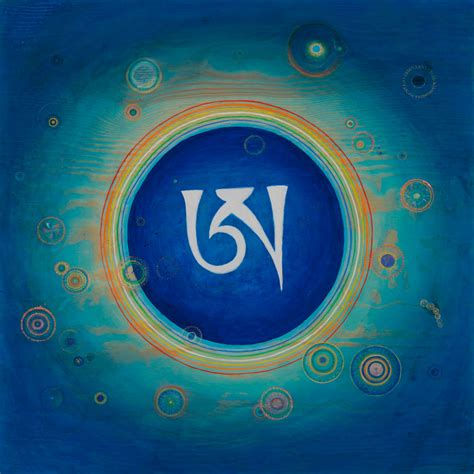
Image: The Tibetan seed syllable A, as visualised in the meditation practice: The Guru Yoga of the White ཨ